The psychology of dice mechanics
 "The Physician Curing Fantasy" (c. 1600), by Mathieu Greuter. Public domain.
After writing my previous blog posts about the Valley as a System (which you can read here), it occurred to me that the initial Minimum Viable Playtest (MVP) I was building didn't actually hold together tonally.
Partly, this was because the dice mechanic favored positive outcomes, creating a "cozy" feeling that didn't fit the core concept - the idea that the valley surrounding the village could consume you if you aren't careful.
As a result, I spent the last few days researching various dice mechanics. To be honest, I lost count of how many different approaches exist, but the research naturally shaped the central question of this post: How do dice mechanics influence player psychology?
Because of the sheer variety of systems, I’ve grouped them into categories to address them separately. Please note that this list is not exhaustive and it covers only the mechanics I am familiar with.
Linear dice mechanics
Let’s get the most popular category out of the way first. Linear dice mechanics are those with a flat or uniform distribution, meaning every outcome has an equal mathematical chance of occurring. Most d20 and d100 systems fall into this category.
In this hobby’s space, these are often called “swingy” due to their unpredictable nature. This isn't to say the individual results are more random than other systems, but they often invite a cognitive bias where players perceive the outcome as chaotic within a binary system of "pass" or "fail".
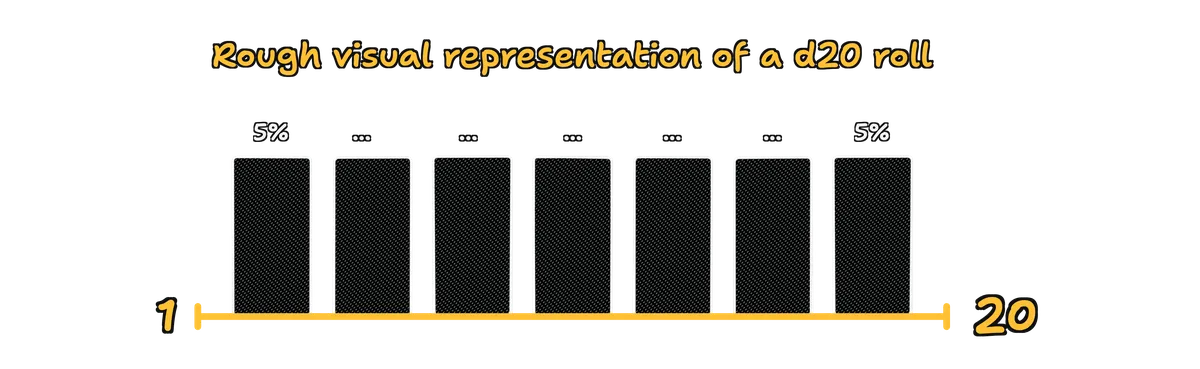
This brings me to the perception of fate. Both d20 and d100 linear mechanics can be viewed as a "coin flip with more sides," which directly affects how players process failure. While every roll is technically "up to fate", players within a binary system will naturally try to manipulate that fate to reach their goal.
Julian Rotter developed a psychological framework regarding how strongly people believe they have control over the situations and experiences that affect their lives.
This framework, called the Locus of Control, suggests that each person has a "locus".
It can be either:
- Internal - a belief that one can control one's own life.
- External - a belief that life is controlled by outside forces, such as fate or luck.
A d20 or d100 roll is purely external by nature. You roll it on the table and see what happens.
However, I’ve noticed that players - particularly in physical, offline play - develop rituals, such as using lucky dice, specific ways to roll the dice, dice jails to punish “bad” dice, or even fish for for modifiers / advantage.
These behaviors are attempts to reclaim a sense of internal control that the mechanic inherently denies them.
For my project, I likely won't use either type of die. While the "realism" of a d100 (e.g: "I have a 65% chance to lockpick this") might fit the tone, it doesn't quite satisfy my specific design needs.
A special exception in this category is the "success bands" from Quest by T.C. Sottek. It uses a single d20 for everything, but makes use of tiered results to influence the feeling of fate (and fate is a big thing in Romanian folklore, relevant to my project). This shifts the psychology from binary outcomes to more nuanced ones.
Curved dice mechanics
I am using “curved” here to describe dice mechanics where results cluster around the median to form a “bell curve” distribution. These systems tend to make outcomes more predictable, creating a sense of consistency. I commonly found this in systems that use a pair of dice, such as Powered by the Apocalypse, Cepheus Engine, and Draw Steel (unsure what MCDM’s system is called)
As a bell curve is statistically likely to produce an average result, characters feel more reliable during play. This provides players with a grounded sense of… normalcy (I am unsure if this is the correct noun form).
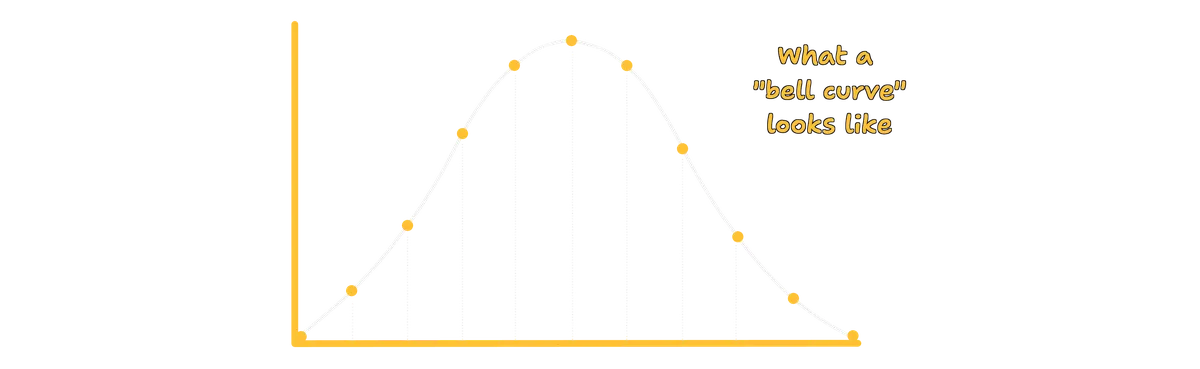
This occurs because of a mathematical phenomenon. If one roll is an extreme outlier (such as a critical failure), the next result is more mathematically likely to be closer to the middle. This transforms outliers into significant story moments rather than just pure bad luck (looking at you, d20).
Interestingly, this can also backfire psychologically. Daniel Kahneman and Amos Tversky coined the term Loss Aversion, which we now understand as a cognitive bias where the pain of losing is more intense than the pleasure of gaining the equivalent.
Say, were I to steal 100 euro from you, would you feel more strongly about that loss than you would about winning the same amount? We can apply this same theory to dice mechanics.
Because bell curves create an expectation of success - or at least a "middle result" (think about the "weak hit" in PbtA) - a total failure goes against what the player has internalised as the baseline.
When a player fails in a curved system, it is more than a simple "miss". Psychologically, it goes against their expectations. The failure feels amplified because it breaks the mold of the established norm, triggering loss aversion more intensely than the usual disappointment of a bad roll.
Afterward, as the player returns to a streak of "normal" results, their brain stops feeling the sting of the outlier and recalibrates to a state of equilibrium... until the next failure hits. And boy does it hit!
This has some interesting design implications:
- Failure can hit much harder in bell curve systems than designers sometimes intend (unless they are fully aware of the math and specifically prefer that outcome).
- Curved dice mechanics are a particularly good fit for drama. A bad result breaks the norm and could carry real emotional impact on the story.
- It can make success feel less exciting. This has been my experience with Draw Steel, where I became so confident in my ability to roll a "hit" that the results rarely felt exhilarating.
Dice pool mechanics
Ah, dice pools - probably my favourite way to handle dice. There’s something uniquely satisfying about grabbing a handful of dice and rolling them all at once.
It’s important to mention here that, given enough scale, dice pools closely resemble bell curves. However, they deserve their own category because player agency makes a real difference in how they are perceived.
Adding more dice to a pool feels like doing more, even when the mathematical impact is, let’s say, modest. The physical act of grabbing a handful of dice that you earned creates a sense of “working towards a result”.
In fact, there’s a specific cognitive bias at play here too, called the Effort Heuristic. It suggests that we assign value to an object based on the amount of perceived effort that went into producing it.
This just gave me a great blog post idea about how minimal systems are not of “poorer quality”, and why people who perceive massive rulebooks as inherently better are likely biased. But I digress.
Coming back to it, the same logic applies to dice pools. A successful roll is more satisfying when we feel we’ve put more "work" into it. Growing the size of the pool looks and feels like more effort, which makes success feel earned and failure feel meaningful rather than arbitrary.
Since I mentioned "growing" the pool, there is another psychological concept worth noting. Carol Dweck describes a Growth Mindset as one that embraces challenges, persists through setbacks, and views failure as a temporary learning opportunity.
In tabletop terms, a growing dice pool reinforces the idea that "skill" can accumulate. Adding dice is a literal, physical representation of getting better. It suggests that players are not merely at the mercy of fate, and a larger pool is a visual manifestation of their agency.
Even within the family of dice pools, there is an important distinction to make:
- Hit-counting: In dice pools where you count "hits" or "successes" (such as the Storyteller System or Year Zero Engine), every die participates. Each die added contributes directly to the outcome, which ties nicely to the effort I mentioned earlier.
- Keep Highest: In dice pools where only the single highest die actually matters, the pool functions like a collection of lottery tickets that increase your chance of "winning." This is commonly found in systems like Forged in the Dark or the Resistance Toolbox.
While there are surely creative dice mechanics beyond what I’ve covered here - not to mention diceless systems - I’ve narrowed my own game’s design down to dice pools or bell curves.
I want to avoid the feeling of a completely "swingy" or random world, yet I don't want players to feel over-competent either. In my setting, the world is watching and reacting, and fictional positioning will heavily influence dice rolls.
I might also consider a more unorthodox route: dice pools that shrink based on deliberate player choices, embracing attrition.
But for now, back to the drawing board.