Attrition as a growth mechanic
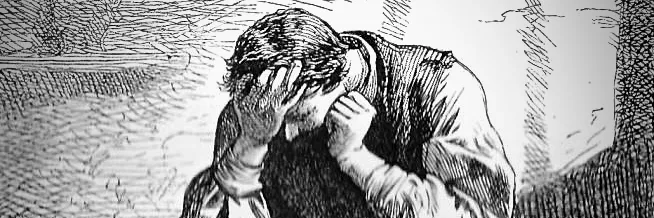 "The Solitary Prisoner" (1874), by Marcus Stone and E. Dalziel. Public domain.
Lately, I’ve been thinking quite a bit about my experience with mainstream tabletop games, where my approach to character development felt isolated from the rest of the group. In an attempt to figure out why, I realised it boils down to how different players perceive development driven by opposing concepts.
In a hypothetical situation where one player sees progression as gaining new tools and the other sees it as the loss of the old, tension is bound to rise where those two perspectives clash.
Looking at how mainstream games are designed, the commonly accepted definition for character development seems to be the hoarding of levels, items, and powers.
Why is hedonism common?
When we break down progression in most popular games - whether video games, board games, or tabletop RPGs - a common theme is the acquisition of possessions.
This can take the form of levels, skills, mechanics, booster packs, or higher modifiers. Naturally, this creates a dopamine-driven feedback loop, where the anticipation of rewards influences player motivation and behaviour.
We can reason from this that dopamine is an engine for player engagement, making "hedonistic" design common for the sake of prolonging a game’s lifetime as a product.
In behavioral psychology, the "hedonic treadmill" describes the tendency of people to return to a relatively stable baseline of happiness despite major positive or negative fluctuations.
Applied to tabletop games, this suggests that after acquiring a new… let’s say… ability, players will eventually return to their baseline level of excitement. Think about how this baseline also changes in high-level play.
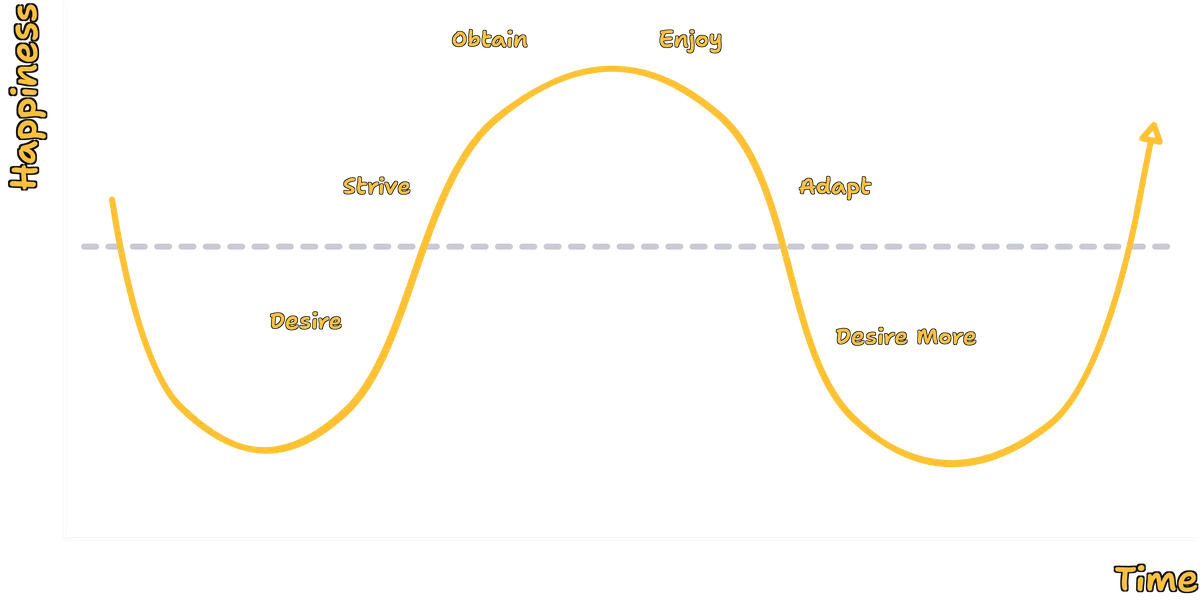
Players might start by desiring a certain ability locked behind a level or a rare item costing tens of thousands of gold pieces. They strive for it, using that desire as motivation.
Once the shiny new thing is obtained, they are at the peak of excitement, bathing in the dopamine, before adapting to the new reality of possessing it.
Then, once the excitement cools, the natural next step is to focus on the next best thing, repeating the cycle over and over again.
Disintegration can be positive
This cycle is vastly different for a player who finds pleasure in the process of transitioning between states. For such a player, growth is the act of looking back and realising how far they have come, regardless of possessions.
In the field of personality development, Dąbrowski theorised that tension and anxiety are necessary for personal growth. His theory of "Positive Disintegration" proposed a model where the breakdown of existing psychological structures allows individuals to reorganize their priorities and values, leading to psychological growth.
You probably figured where I am going with this. If disintegration is viewed as a positive process in psychology, what if we applied that theory to tabletop games?
Specifically, I am interested in the inversion of growth. Instead of defining growth as adding elements to a character sheet, what if growth occurred by removing parts of a character?
This likely appeals more to players who prioritise emerging stories or "playing to find out" over "builds", but it gives growth more diegetic nuance.
Loss is diegetic advancement
When players engage with the fictional world or narrative space, they are engaging with the diegesis. If a roleplaying game lacks diegesis, its mechanics have no in-world justification.
This is why we should aim for growth that is diegetic in nature. Progression that occurs directly within the shared fictional reality, independent of arbitrary elemenets like XP points.
If we reframe loss as part of growth, it becomes a process of adaptation. It is a progression from who the character was to who they are now because of that loss.
In the fiction, if a character loses a hand during a dangerous encounter, the player adapts to being one-handed, carrying the scar as a badge of honor.
Similarly, if a character undergoes an intense psychological event and becomes hesitant, it influences their future actions and the emotional texture of the game. A +2 sword or an increased DC simply cannot achieve any of that.
Designers already do this
My goal is not to reinvent the wheel, but to share my thoughts on the importance of "loss." In fact, many designers in the tabletop space already make use of "loss as growth". Attrition is the commonly used term, and several games integrate it gracefully.
"If we're willing to step back a bit, to not suffer their trials as personal failures, to imagine them as perseverant when we ourselves might quail, we might get to see them win past pain and despair into something else. It's a long shot, but they're up for it." - John Harper
In Blades in the Dark, for instance, Harm, Stress, and Trauma work together to ensure scoundrels undergo constant physical and psychological changes. One of the core principles of play is to throw yourself into danger and embrace change.
Pendragon is also a worthy mention. Despite its simulationist nature, it romanticises the cycle of life and death to the point where attrition becomes central. It uses generational play to turn decay (characters age every session), death, and legacy into an attrition engine.
In the NSR space, Cairn is a perfect example of how Scars change characters too. Once Hit Protection is gone and Scars are received, they directly impact how characters behave in the story. Being "deafened" or "diseased" forces the player into new fictional positionings.
Attrition is perhaps another branch of "killing your darlings". Nonetheless, it is a valuable experience that can evolve characters into more complex versions of themselves.
It’s vital to frame these moments as a narrative promotion rather than a penalty. Characters are survivors who find new, deeper ways to exist within their world.
Loss is not an end. It is a pivot point.