The valley as a system - Part 1
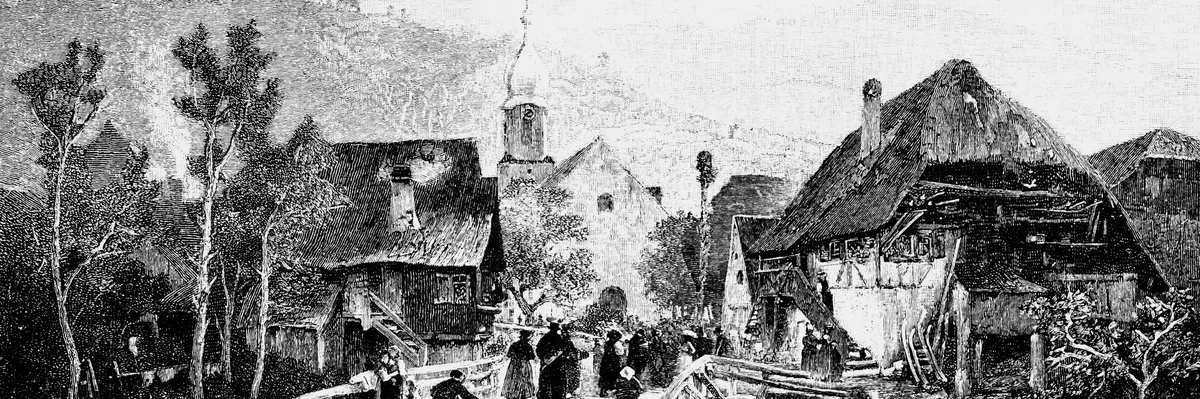 "Schwarzwalddorf" (1880), by Albert Kappis and Emil Hofmann. Public domain.
One of the current projects I work on incorporates Romanian folklore to give the game setting a more unique flavour. Because most tales are passed down through oral tradition, it’s difficult to centralise these myths and fables. Yet, a common theme seems to be the valley as a liminal space.
Valleys provided mostly everything a village needed to survive, regardless of how isolated it was, but they also acted as thresholds between opposing forces: the hearth and the wild, the seen and the unseen, and - most importantly - this world and the other.
This does create a problem for my game’s design. At this scale, standard hexcrawls simply collapse. Standard hex sizes are usually 6 miles (~9.5 km). For a Romanian village, a single hex can cover the entire world known by the village. By the 8 mile mark (~13 km), you walk into the "beyond," where the forest will claim you. So instead of mapping distance, I need to map exposure.
Nodes as decisions
When designing this game, I intend to use existing procedures from the hobby space rather than inventing a completely new system. Yet, I need to adapt them to my specific use case.
Most players agree that pointcrawls are a mixture of locations and nodes, making travel through various points - aka "crawling" - rather straightforward. However, in a valley where villagers know their immediate vicinity and can reach the furthest point in a couple of hours, distance loses its importance. Instead, every node should prompt decision-making.
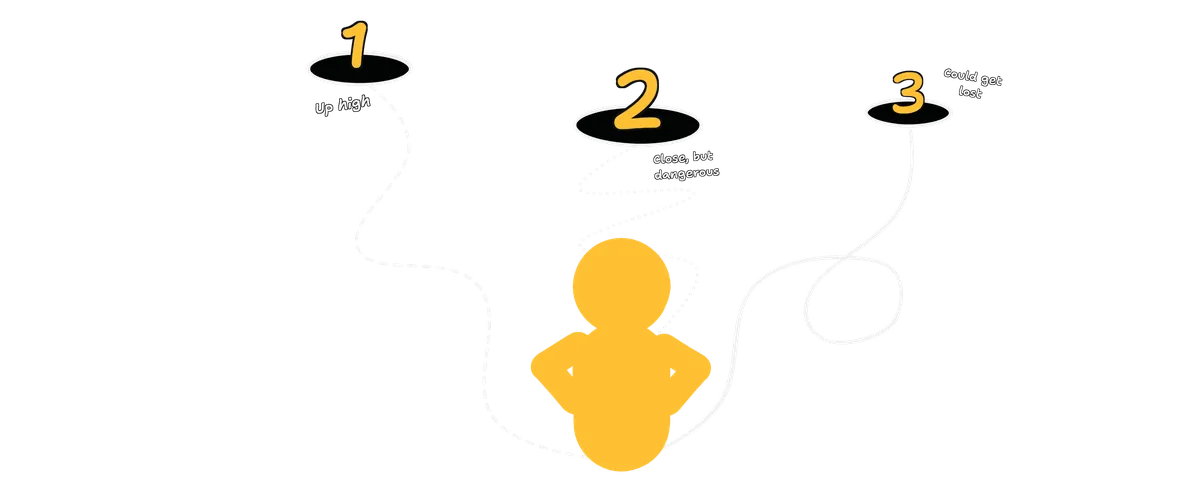
For example, due to the small map, players will always know where the communal well is. This shifts the mindset from "Can we find it?" to "Is it worth it?". The decision becomes one of trade-offs rather than capability. Because such villages often lacked all the tools one might possibily need, characters won’t be prepared for every scenario either.
Some paths might be shorter but exposed to volatile spirits, while longer routes provide more safety or the other way around. As tension rises and falls, players will ask themselves what do they gain, and what do they lose. Each decision then carries an implicit cost: time, risk or exposure.
In Romanian folklore, the night in particular is also the most dangerous time of all. If someone did not return by dusk, the villagers would often begin funeral preparations. It was uncommon for people to return the next day (and even rarer after several days) if they had only left to do a task in the area.
From a player’s perspective, if a village is starving and the only food sources are high up the slope, closer to danger, they must wonder: Is the village's hunger worth going out into thin air and misty places?
Planning a village infrastructure
To reinforce the focus on the valley as a small-scale region, the village - a social hub at the center of it all - must have a proper infrastructure associated with it. It shouldn’t be just a place for players to return to. Rather, it should be a social and symbolic machinery that aids the humans over time.
Instead of being simple points of interest, nodes surrounding the village must serve a purpose, and their connections to the village should reflect the local lifestyle. In isolated Romanian villages, infrastructure was often maintained through communal labour, where everyone contributed somehow. Joining hands to maintain or protect these "nodes" became akin to a rite of passage.
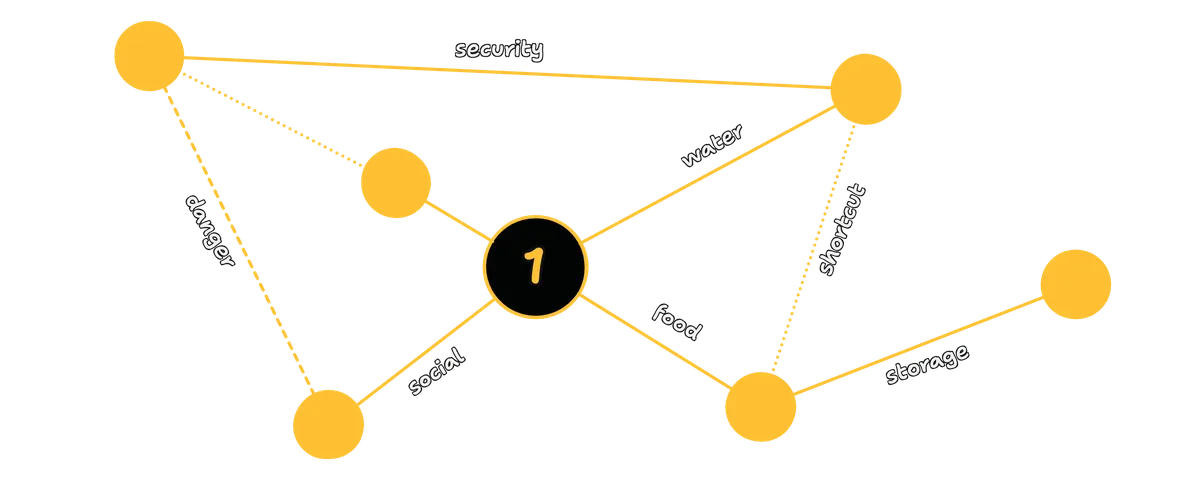
Imagine the act of transporting grain from the mill back to the granary near the hearth. It is a transition between two states of being: leaving the village with the metaphysical weight of hunger on your shoulders and returning with the physical weight that can feed the community.
The mill, therefore, is not merely an interesting location. It serves both a logistical function (supplying the village) and a social one (a trial for those who venture beyond their home for the sake of the collective).
Similarly, the boundary stone in Romanian folklore acts as a protective barrier against evil spirits. Typically placed where a road enters the valley or in the immediate proximity of the village, it transforms a dangerous geographical point into a "sanctified" one.
In other words, even the simplest node - be it a bridge, a stone or a tree - can become vital as long as it serves a clear function. If the players fail to maintain the infrastructure, the "wild" quite literally gets closer to their beds.
The idea of a node collapsing and affecting the village dynamics captivates me. If a boundary stone is destroyed, danger looms closer. By contrast, if the players perform a ritual to sanctify the communal well, the darkness takes a step back.
This kind of exchange also influences how nodes are organised by risk levels. Both the players and the GM benefit from a mutual understanding that traveling to a node where the village influence is weak increases the tension and potential exposure to threats.
In a follow-up article, I will explore areas of risk and how borrowing a mechanic from another game fits perfectly with the concept of "exposure" I’ve been discussing.
In fact, this design reminds me of the West Marches philosophy, and it is interesting to see how that approach to a shared risk space applies here.
While I might not have multiple parties exploring the same valley, the core question remains…
Among those who dare to venture out, how many will return?