The valley as a system - Part 2
Last time, I explained how villages in Romanian folklore function as liminal spaces, often secluded within geographical valleys. Mapping nodes as decision points, rather than using traditional hexes, proved to be a valuable exercise for helping future players assess danger.
The danger must also reach the village itself. Its infrastructure (the very way of life for the community) should be constantly under threat if the players are not careful.
That brings us to this second part, where I plan to expand on my perception of risk, how I could incorporate it further into the game, and how to reflect it within the core dice mechanics.
What is risk?
Depending on whom you ask in the tabletop design space, you will receive a different definition of "risk." Some games view risk as a gamble, others consider it the possibility of mechanical failure, and others describe it as pure uncertainty. The common thread is that risk represents the potential for negative outcomes.
In a village where being gone for more than a night leads to your community assuming the worst, risk also becomes an existential theme. It threatens the well-being of the community and the bodily autonomy of anyone who wanders too far beyond the sanctified grounds of the “core”.
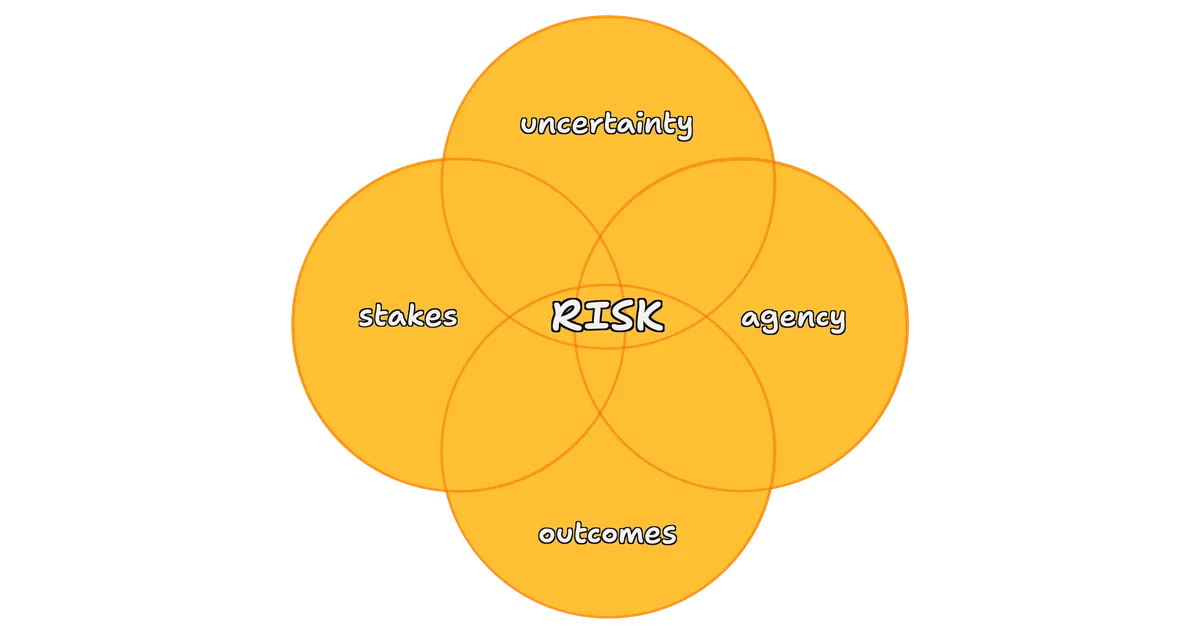
If we define risk as a combination of:
- Negative outcomes
- Uncertainty
- Stakes
- Agency
...then I need a way to increase these factors the further players travel from the social hub.
While familiarity provides comfort, the less familiar a space becomes, the higher the stakes rise (What can I lose?), the more player agency matters (Do I push my luck?), and uncertainty begins to dig around (What if I run into something in the dark?).
This also influenced the idea of using a gradient of safety in my game's design.
The safety gradient
I keep mentioning the small scale of the valley because it is vital for setting both tone and expectations.
In a traditional hexcrawl, danger is often tied to distance. Remote hexes are typically unmapped and poorly supplied. In other words, the further you travel, the more dangerous the journey becomes due to the "fog of war".
By contrast, in my game, players will know the extent of their environment. More often than not, they might even know what a specific node contains (not the secrets or hidden dangers, of course). In the context of village life, the valley is their entire world. Many dared to venture into it before, and others might continue to do so.
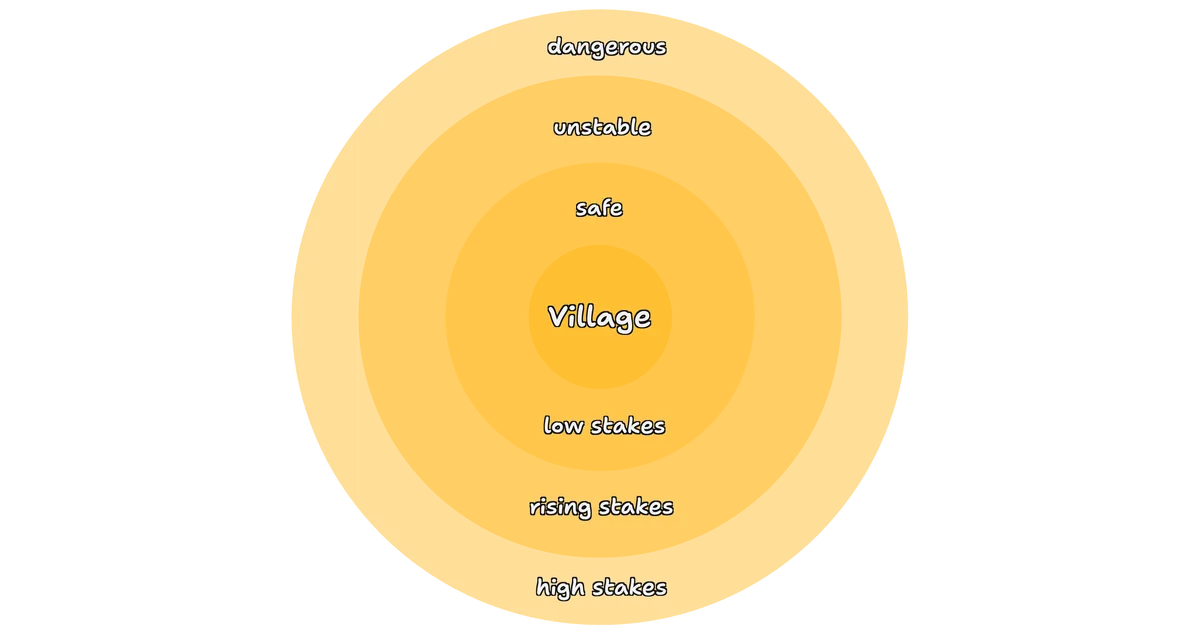
This shifts the focus from "how far away something is" to "how far outside of protection it is". In my game, safety doesn't end in fixed places. Instead, I want safety to fade, shift, and transform.
But theory and practice are different.
To make this usable at the table, I need a gradient:
- Ring 1 - Safe: This is where daily life happens and where the village’s influence is strongest. If something goes wrong, someone will come looking. Even at night, there is still a sense of protection.
- Ring 2 - Unstable: This is where players begin to feel tense. Nodes here are not within the village’s immediate reach, but not entirely outside the village influence either.
- Ring 3 - Dangerous: This is where the actual reach of the village ends. The rules that govern the community do not apply anymore here. Nodes are not simply more dangerous, but different in their characteristics too.
The important distinction here is that nodes are not fixed. Nothing is permanent. Player actions and the consequences they encounter can and will shift which nodes belong to which safety level.
The inspiration for this stems partly from Apocalypse World 2e's threat map, and partly from Stephen Covey’s "Circles of Influence". More so the latter because it psychologically maps to what the village can control, what it can influence, and what lies outside of its control.
Tension for time tracking
A few days ago, I asked the community on the Murkdice Discord server if anyone had played Adventurous by Dawnfist Games. I was particularly interested in its dungeon exploration system, which is described as a way to "automate time tracking and keep tension high".
It turns out several other systems use similar logic, such as The Angry GM’s Tension Pool and the Doom Dice in Witches of the Wenderweald by Odinson Games (do check it out - the zine is gorgeous!).
This gave me three distinct examples of how dice pools can be used to model escalating tension. According to Odinson, this mechanic is very fun in person too, especially if you want to keep the players moving.
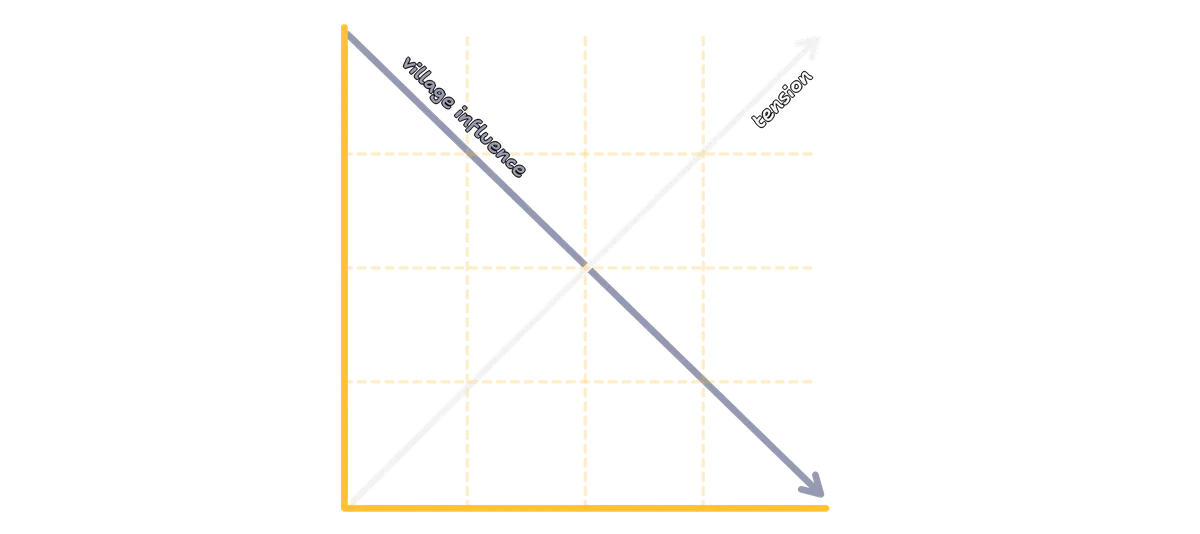
This brings me to why I believe this can function as a time-tracking procedure. Instead of dungeon turns, my units of time are travel between nodes and actions taken at nodes. Each move or time-consuming task adds a die to the pool.
The pool isn't just an abstract clock this time - it represents how far the village’s influence has faded and to what degree the wilderness noticed the players. In essence, it tracks both time and exposure.
How I plan to implement this:
- Moving into or between "Unstable" nodes adds 1d6 to the Tension Pool.
- Performing a time-consuming action also adds 1d6 to the pool.
- Moving into or between "Dangerous" nodes adds 2d6 instead.
- When the pool reaches 6 dice, the GM rolls them against an Encounter Table.
- If players are reckless, the GM may roll the pool immediately too, regardless of how many dice it contains.
- Each "Circle of Influence" has its own Encounter Table, showing how threats near the village differ from those in the wild.
- "Night" might be a dedicated result with its own table. The node's safety level could dictate the nature of the encounter.
I also consider a way for players to deliberately roll the pool. Giving them the agency to invite their own demise should make for some very interesting stories, right? Right?
With that, we have reached the end of this two-part series. I hope that thinking out loud through my design process has offered some useful insights for your own games as well.
This process has certainly generated some exciting ideas for this upcoming project...
…and for the monsters within.