Prepping heists, reimagined
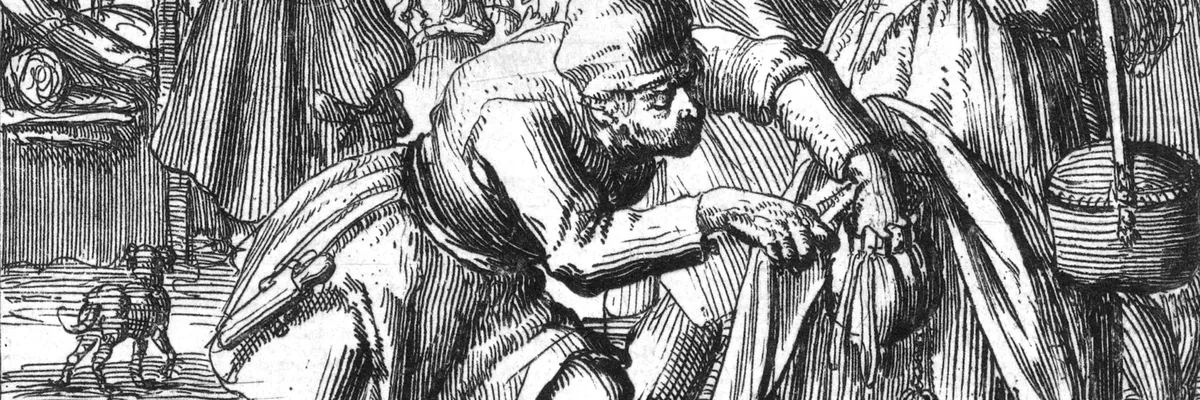 "A thief empties the money pouch of a woman" (c. 1750), by Jan Luyken & Andreas Hondorffius. Public domain.
I was reading the news the other day and came across an article that resurfaced a rather important event for my country last year: the theft of artifacts of great archaeological (and monetary) value. They were stored in a Dutch museum which, from what I gathered, was quite secure. However, that didn’t stop a group of shady individuals from blowing the walls up and going in to steal the goodies. Being reminded of this event actually got me in the mood for a topic I haven’t explored in a while: heists.
Last month, the Melsonian Arts Council also had a pretty big sale on their website, and that’s how Swyvers came to my attention again. Reading it was a very fun experience because Luke Gearing’s voice was particularly thematic for this specific game, and it really got me in the mood for some thievery (the legal, fictional kind, I promise).
Associating Swyvers with the OSR scene made me curious about how much heist content is actually out there, and that’s when I realised the answer was rather disappointing. I genuinely expected tons of third-party content, in line with how many modules and adventures you see in this space. Instead, I found a conversation on the NSR Cauldron discord server about how “heist adventures are difficult to write for most OSR creators”.
Now, I am no OSR guru - in fact, I am extremely far from it. I am more interested in the new school, and my background is almost entirely that of a storygamer. Still, it made me wonder: is there nothing we can do to make heists a bit more accessible to creators… or at least to GMs?
The way I used to prep heists
Blades in the Dark is that one title that constantly pops up on my blog because it influenced me greatly. Not only did it introduce me to the wider world of roleplaying and help me break away from those evil wizards sitting on a coast, but it also kickstarted my GMing journey.
That means most of the heists I ran were, by a large margin, in that style of play. Prepping had always felt like a beast I couldn't handle. My prep used to consist of entire pages of story beats that my players had to go through… until I started prepping Blades.
Because Blades is a rather dense game and I felt overwhelmed by the number of elements I thought I needed to track, I searched far and wide for a prep framework that could work for me. That’s how I found the prepping toolkit from Rolling a Hard Six.
After adopting it, most of my notes involved a short description of the heist, along with bullet points for three obstacles that were likely to attack the players, three obstacles that were likely to notice or observe them, and three obstacles likely to physically block them from something - anything. I usually added a plot twist on top, too, because who doesn’t like a good twist?
Three was a rather arbitrary number that I used simply because I wanted to limit myself and challenge my old habits. It doesn’t have to be that number specifically. Similarly, does it even have to be Blades in the Dark for this to work? I like to believe not.
Planning with a new mindset
The main friction point I can think of is how planning is approached. Storygames thrive on the story itself being interesting, while OSR games thrive on player skill - and player skill requires reliable levers, often in the form of items.
For a heist, this means that Blades in the Dark can do away with planning entirely. In fact, it skips it altogether by often starting in medias res, and also using the Flashback mechanic and the Loadout system (which gives you retroactive access to items on your character sheet) to fill the gaps.
OSR heists, on the other hand, benefit from more detailed planning. In fact, I’d go so far as to say they need that planning to happen in order to increase player survival rates. Just like in real life, if you go in with the wrong tools for the job, it can backfire drastically (not speaking from experience, of course).
But what if you’re like me, and you despise granular shopping scenes and don’t want to spend an hour discussing every potential scenario? Well, that’s where I think front-loading information about the heist comes in handy. Because we want players to prove their skill during the heist, not before it, and showcase their ingenuity while interacting with whatever situation emerges at the table, I strongly believe they should know the nature of the heist beforehand. In other words, information as inventory.
Instead of asking them to squeeze their brains dry at the very beginning to earn information, be generous. Tell them, through the fiction, what they can expect.
For example: lately, workers from the slums were hired to build a wall around the mansion, suggesting that rope and climbing gear might be needed. Perhaps rumours claim the noble is highly possessive and keeps her valuable jewelry within a seemingly unbreakable vault - nothing some explosives can't fix.
Shift the focus away from planning which items to buy and toward how they learn about the heist itself. Similar to how a player might look under a rug to find a key without needing to roll for it, prepare some "truths" about the heist that they can uncover at the very beginning within a limited time.
Asking around the slums, eavesdropping at a high-society event, getting a local baron drunk, or trading favours - all of these can provide advantages that you can resolve quickly, perhaps even off-screen. They might even learn about other obstacles, such as potential spotters!
Designing the heist
Putting this “information as inventory” mindset and the previously mentioned toolkit together could result in a new framework that works for OSR and NSR games alike.
I don’t think a heist needs more than:
- A premise or a few hooks to randomise the starting point
- Physical or abstract treasure to reward the players
- A thematic encounter table to introduce dynamic challenges
- Enemies or, in our framework, different types of obstacles
- A few keyed locations to explore
In fact, while chatting with the folks on the Murkdice discord server, I learned that anything can be a dungeon (this was after I initially said I found dungeons boring and repetitive). If you think about it, a heist could easily be run as a five-room dungeon. A heist maps cleanly onto that structure, since both are really just a tight sequence of entrance, obstacle, twist, climax, and reward.
In terms of flow, I imagine a heist structured like this: Hook (the heist opportunity) > Intel (information as inventory) > Execution (engaging with obstacles and keyed locations) > Extraction (escaping with the loot). The main shift here is that instead of stocking a map with generic enemies, we use three distinct types of obstacles (attackers, spotters and blockers) that each serve a different purpose.
Player skill then arises from circumventing spotters, figuring out ways to escape attackers, and creatively using tools to bypass blockers. Engaging with an attacker does not have to mean fighting them, just as engaging with a spotter does not mean automatically being noticed by them, as long as danger is telegraphed.
Furthermore, random encounters could be triggered once the tension or the alert level rises high enough to prompt a roll on the table, and that table could include additional obstacles. Anything to get in the way of the players making it out with the goodies they desire! After all, nothing screams creative problem-solving quite like trying to pull off an extraction while someone tries to steal your getaway wagon.
Just keep in mind that these categories are purely GM-facing to help you design a heist - they aren't something your players need to know about.
In fact, they should never hear terms like "spotter" or "blocker" at the table. What they encounter instead should be specific enough to act on through fictional positioning. Instead of a Blocker, show them a chained door that cannot be opened quietly. Instead of a Spotter, introduce an old butler who gets scared easily.
These roles can shift, too. For instance, a guard dog (which the players also learned about at the beginning maybe) might start as a spotter, but once it catches a scent, it becomes an attacker. Let your rulings (not the category!) decide what an obstacle does in the moment.
Tables for everyone
To close this off, I don’t want to leave you with just theory, so I did my best to create a few short tables for your own use. To maintain consistency with my own prep style, the tables below are specifically for attackers, spotters, and blockers. Feel free to use them, adapt them or break them apart.
Table 1: Attackers
| d10 | Attacker | Description |
|---|---|---|
| 1 | A violent dog | It doesn't bark. It bites. |
| 2 | A rival thief | Another criminal who operates nearby. |
| 3 | A greedy servant | Demands payment to cooperate. |
| 4 | A drunken noble | Reckless, intrusive, and oblivious. |
| 5 | A guard patrol | They are rushing somewhere. |
| 6 | A swarm of pests | Rats, bats, insects, or similar. |
| 7 | A collector | Quite eccentric. Tries to blackmail. |
| 8 | A persuasive demon | Wants to strike a forced bargain. |
| 9 | A vengeful spirit | Possesses an object owned by players. |
| 10 | A magical ward | Inflicts harm on trespassers. |
Table 2: Spotters
| d10 | Spotter | Description |
|---|---|---|
| 1 | A loud dog | It's all bark and no bite. |
| 2 | A bored guard | Desperate for something to happen. |
| 3 | A gossiping servant | Notices every unfamiliar face. |
| 4 | A curious child | Fearless and difficult to deceive. |
| 5 | A paranoid neighbour | Peeking through windows. |
| 6 | A vigilant cat | Followed and adored by staff. |
| 7 | A focused butler | Knows exactly who should be present. |
| 8 | A nosey parker | Meddles in your affairs. |
| 9 | A dust pattern | Disturbances are immediately obvious. |
| 10 | A mirror network | Mirrors share reflections. |
Table 3: Blockers
| d10 | Blocker | Description |
|---|---|---|
| 1 | A locked door | Frustratingly mundane. |
| 2 | A collapsed passage | Rubble or debris blocks the way. |
| 3 | A guarded gate | Requires a password or bribing. |
| 4 | A complex lock | Opening it takes some time. |
| 5 | A vertical shaft | Climbing or descent is difficult. |
| 6 | A hidden entrance | Must first be discovered. |
| 7 | A narrow space | Some equipment can't fit through. |
| 8 | A big crowd | Occupies the main area. |
| 9 | A rotating puzzle | Involves a secret mechanism. |
| 10 | A magical barrier | Requires spellcasting to open. |
Additionally, I recommend checking out this trap toolkit to generate tip-top traps, these NPC templates to give your heist a bit more social weight, and this table to connect your keyed locations just in case you need to scale up your heist.
That Drents Museum heist worked because someone knew exactly what they wanted and how to get it. Give your players the same clarity, and watch what they do with it.
Stay sneaky out there.