Minimal games have maximum intent
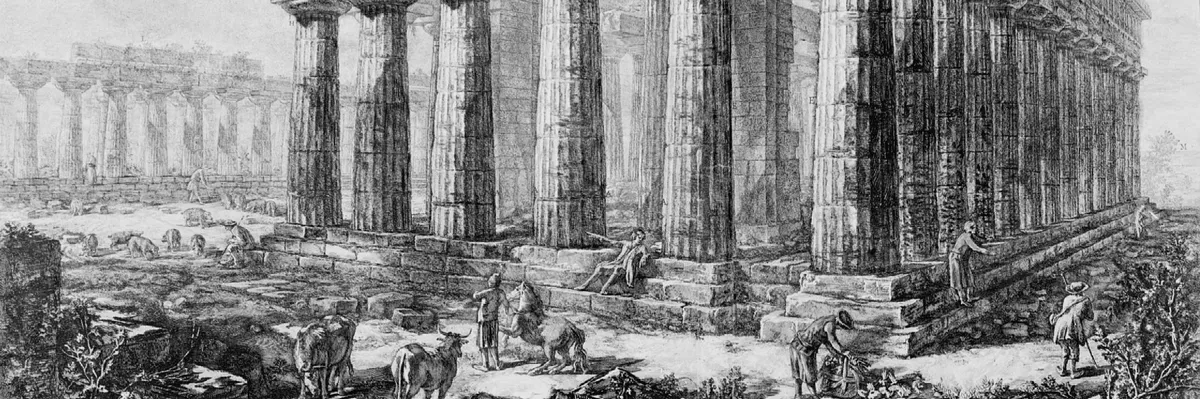 "Neptunstempel in Paestum" (c. 1750), by Giovanni-Battista Piranesi. Public domain.
Wherever you look in the TTRPG space, you are likely to come across discussions about certain games being better than others. It’s probably in our human nature to constantly categorise and compare things to make sense of our world - just look at the many attempts to create a TTRPG taxonomy - and our hobbies are no exception.
That said, I’ve noticed a pattern where "value" is often associated with titles that boast a high page count and dense mechanics. It is as if "better" is defined by a bigger rulebook, and anything smaller is perceived as incomplete.
However, if you were to ask five different people in five different spaces, their definitions of "value" would probably lack consistency. Given how subjective "better" truly is, I want to argue in favour of rules-light games. To me, value lies in intent (and diegesis), and that is the lens I will use going forward in this post.
Instinctive bloat
Reading my other posts, you probably realised I am a fan of recognising cognitive biases, and I think one might be at play here too. In the few tabletop design spaces I am part of, designers have a tendency to add more elements to their games in order to improve them. I am unsure if this pattern persists in professional design too, but it seems like a common question is “What if I need rules for X too?”
In other words, when some designers figure out a challenge they are faced with, their first instinct in the situations I observed is to add mechanics rather than rework them, remove them or keep things light. This directly maps onto a cognitive tendency known as the Additive bias.
And I can’t blame them. When you look at the market within the tabletop industry, most big titles are produced by corporations and showcase multiple books with over 250 to 350 pages each. Dungeons & Dragons (Hasbro) and Pathfinder (Paizo) are particularly infamous for this. It would be foolish to blame any designer, who wants to make a living out of this hobby, for thinking they need hundredsof pages of rules to match that.
If you’re a designer reading this, know that you can build small and no one who matters will judge you. Less can be more. In fact, a series of experiments by a group of researchers determined that participants were less likely to consider subtraction when they weren’t explicitly presented with the option. We need to support more minimalist games to show everyone that they do exist, and that going against the instinct to add more mechanics is not inherently wrong.
Purposeful mechanics
When your first instinct is to add more mechanics just in case they might potentially show up in play, it creates a lot of baggage - or dead weight, if you will. Surely, it might be nice to have the perceived safety of having a tool ready when you need it, but those mechanics only serve a real purpose when they actually come into play. Otherwise, it’s like packing a wintercoat and boots just because it might snow on a weekend trip.
I have suffered from this both as a player and a GM. Like many people, my introduction to the hobby was Dungeons & Dragons. At some point, I learned about several mechanics that I found interesting but in the types of campaigns I played, they never actually came up.
Later, as a GM, I found Blades in the Dark quite overwhelming. John Harper is a great mind and very open to GMs ignoring the parts they do not need (I believe this is even mentioned somewhere in the book) but knowing what to ignore takes practice I didn’t have. As a new GM, I found the mechanical depth of Blades intimidating because I never knew when I might need a specific rule or ignore another one.
There is a well-known narrative principle called Chekhov's Gun, which implies that every element in a story must be necessary, and irrelevant elements should be discarded. For games that are rules-light by nature, this is particularly important because minimal mechanics must be purposeful. Within a limited design space, there is only so much you can build, and those restraints force you to focus on what matters.
Looking back at Blades in the Dark, it has a tightly interconnected design. If a system includes mechanics for heists, prison life, and turf expansion, which one is the true focus? If my players do not want to start a turf war, you might say that is completely fine and won't break the game, but suddenly those unused rules become cognitive load for the GM.
A GM might worry that ignoring one part of the machine accidentally causes another part to break. I think this is much less common with rules-light games, where players and GMs alike engage with the entirety of the system most of the time, because each part is necessary for the designed experience.
Intended experiences
That naturally brings me back to intent. When designing games, we often begin with a single idea that expands into a theme or a concept. Intent serves as a compass, ensuring that every rule, every mechanic, and every aesthetic choice aligns with that central theme.
My partner studies architectural design, and one of the principles they taught me about is actually a design ethos of the Bauhaus movement: form follows function. If you’ve ever wondered why Bauhaus furniture is so simple and functional, it is because of this principle. It states that the shape, appearance, and structure of an object or building should primarily be based on its intended purpose or utility.
I consider it very relevant to TTRPG design too, because I now believe the design of a game should be tied to what the author wanted to achieve as an experience, rather than pure effort for effort’s sake. We see this in UX (User Experience) too, where websites and apps are structured to help users complete intended actions. It disregards flashy graphics in favour of intuitive design.
Mörk Borg, for instance, is a game I misunderstood for a long time. I thought it simply had cool aesthetics, until I realised that even the aesthetics serve the play experience. The rules fit on a few papers, and every design decision reinforces themes such as doom, lethality, and nihilism. As soon as you hear the title, you know what kind of game you’re about to play, because it achieved its intended purpose so faithfully.
Into the Odd is especially appreciated within the New School for how lean and elegant it is. The mechanics there are clearly not the focus, but the flavour is, which is reinforced by the tagline “rules-light, flavor-heavy”. Players are explorers faced with industrial horrors, and the expeditions, monsters, and the game’s equivalent to magic support that.
Another example is the 2400 series of micro-games by Jason Tocci. In fact, they are more like modules that you can plug and play whenever you want something that runs on descriptions and narrative positioning over detailed rules. There’s a very strong reliance on emergent fiction within its usual sci-fi theme and the 24XX prefix is known for that.
All of these games, and many more, understand that tabletop games take on the shape of the desired experience. In other words, they do not focus on simulating a perfect world, but rather on the behaviour, pacing, emotions, and decisions they want at the table.
Perhaps a common thread here is that their intent often covers meaningful character choices, rising tension, player interpretation, and, more than anything, improvisation. The latter is particularly important because, when the desired experience doesn’t require a multitude of rules, improvisation and collaboration fill the space.
Tomes full of mechanics or rules are not quantitatively necessary to deliver a certain experience. Just like the fiction itself, the experience can emerge naturally at the table, born from the intersection of all elements designed with intent.
Looking at everything I wrote today, I think I can summarise it all into three main ideas:
- Bloat is instinctive for designers.
- Unused mechanics become dead weight.
- Intent produces consistent design.
Even with all of these laid out, I can still imagine people being pulled in by thicker rulebooks, perceiving them as more valuable. I mentioned the Effort heuristic in another post, noting how we perceive things that require more effort as more valuable to us. A 400-page book feels fairly serious, but I don’t think that is a proper judgment - I believe it’s only bias.
If you think about it, it actually takes considerable effort to build a minimal game around an intended play experience and achieve mechanical, aesthetic, and diegetic consistency. It’s just that the effort required to design minimal games is not obvious. It fills the space between a zine’s pages and acts as the glue keeping the game together.
Perhaps we should appreciate more often the invisible effort of those who create games for us, because it is a testament to their love for the hobby and to the value they want to give us, the hobbyists.
Dare I say, minimalist design is often the hardest to pull off because there's nowhere to hide the flaws.