Decluttering the table
 "Pickle Herring Street" (1872), by Gustave Doré. Public domain.
Those who have met me in real life know that I only wear black. More often than not, I also wear the same type of clothes (not the same actual clothes!). I could joke and say I adopted the Steve Jobs vision, but the truth is simpler: I couldn't handle the mental load of deciding what to wear every day.
Clothing was only one stepping stone in my journey toward minimalism. Another stone, for instance, involved being comfortable with letting go. Anyway, I firmly believe my life philosophy - centered on minimalism, Zen, and avoiding clutter in both objects and conflict - has heavily influenced my game design.
What is mental load?
Mental load is a common term in psychology-focused spaces. Often called "cognitive labour" too, it refers to the invisible work we do to ensure something (anything) runs smoothly.
This could be a household, a relationship, or a simple to-do list. For this blog, however, I’d like to discuss mental load in the context of tabletop game design (duh!).
According to experts cited by UCLA Health, mental load tends to be invisible, without boundaries, and never-ending.
For a Game Master running a TTRPG, this often looks like:
- Searching their mind for specific rules during a scenario or calculating mechanical outcomes on the spot.
- Spending free time or even work hours preparing the upcoming session (GM prep), then reviewing how it went when the GM could be relaxing instead.
- Constantly striving to improve the player experience while ensuring the world remains consistent with the rulebook every time something new is added.
- Contacting players to schedule games, worrying about where to play, carrying materials, and managing digital tools.
Without proper emotional support, these demands lead to stress, planning fatigue, stagnation, frustrated players, and even burnout.
How can minimalism help?
Minimalism is often described as a movement, but it is primarily an intentional way of life. One of my favorite sayings is: "Declutter your mind to declutter your life." It refers to eliminating cognitive (and emotional) baggage to free yourself, much like clearing unnecessary bits and bobs from your home to free up physical space.
Minimalism can be applied to tabletop design by focusing on what truly matters at the table and stripping away the mechanics that weigh down a GM’s shoulders.
I’ve borrowed a list from The Minimalists to show you what that can look like as a framework.
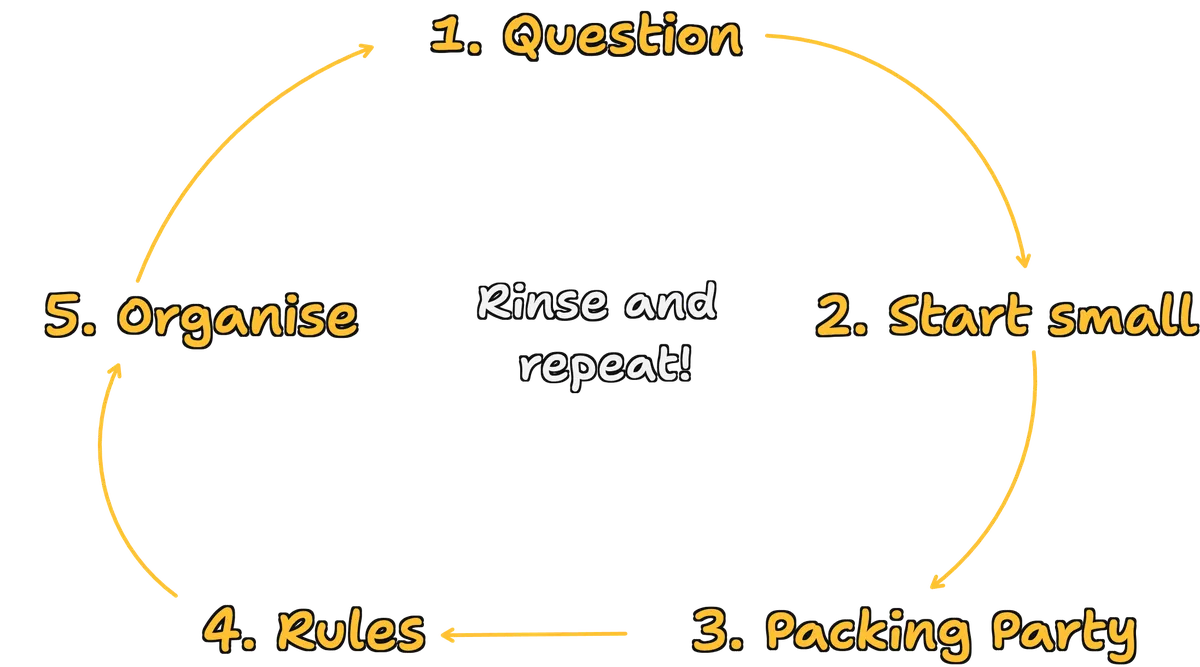
1. Question
Whether you are sketching out a new game or refining a long-term project, ask yourself: "How could my game be better with less?".
This question naturally surfaces the benefits of letting go. As the designer, you define what "better" means. This is simply an exercise in reimagining the game without rigid parts.
In psychology, the Big Five model defines "Openness" as having an active imagination and being intellectually curious enough to challenge authority. In this case, be open to challenging your own authority as a designer.
To improve the game, you don't necessarily have to "fix" it. It's not broken. You just need to entertain a different approach.
2. Start Small
Just like cleaning a home, you don’t have to declutter everything at once. Open your metaphorical wardrobe, look at your mechanics, and decide which ones you could live without.
In design, this could be choosing one facet of your game and removing a few mechanics without breaking the core system. For example: on a combat grid, do I really need characters to move at varying speeds measured in individual feet? If most players move 30 feet and rarely exceed 100, I could turn "feet" into "squares." If 30 feet equals 6 squares, I can just use the smaller number.
3. The Packing Party
The idea is simple: pretend you are moving. Pack "everything" into boxes, and over the next week, only unpack what you actually need.
While we can't literally do this with a game, we can treat the Character Sheet as an "empty state." Act as if you have no mechanics and "unpack" only what is vital for a bare-bones session. Maybe ask yourself: "What is the absolute minimum I need to handle conflict in this story?"
4. Set Rules
If you get stuck, set some hard rules for yourself. For instance, have you designed any mechanics "just in case" players might need them? Remove those first. You don’t need to anticipate every possible scenario because many can be addressed narratively in the moment.
Another method: look at your last ten sessions. Which mechanics appeared consistently? Which appeared once, twice, or not at all? Keep the former, discard the latter. If a mechanic isn't used frequently, it doesn't need a detailed rule. You can use a simple one-die resolution or play it out strictly narratively.
5. Organize
Finally, group your mechanics into "mechanical buckets": Character Creation, Conflict Resolution, Growth, Travel etc.
When you look at these "piles", which one is the biggest? Is that one the focus of your game? Challenge yourself to reduce each pile to only five mechanics... or even three if you’re feeling ambitious! You can even make it a game: give yourself 15 minutes to create a "discard pile." Can you slim down your rules before the timer runs out?
Hopefully, by the time you finish these steps, you will realise that your game doesn’t require all the "fancy" elements you thought were essential. We live in a society that cares too much about material possessions, and that mindset often seeps into game design tropes too.
Your game doesn’t need 100 mechanics to be "good" or "high quality". A 24-page zine can be just as fun as a 400-page Player Handbook or Dungeon Master Guide.
Who knows - maybe it’ll even be more fun. Wink wink.